On the occasion of the 90th anniversary of the birth of Maria Bartuszova (1936 – 1996), we draw attention to the key aspects of her sculptural practice, founded on the experimental exploration of materials and processes.
Her distinctive techniques — such as gravistimulated shaping and pneumatic modelling — reveal a profound interest in the transformation of plaster, from a loose mass to a liquid substance capable of rapid change. It was precisely this process that enabled her to work innovatively with form through the use of rubber moulds, casting, and combinations with natural materials.
Bartuszova's series of intimate sculptures, intended for direct tactile contact, emphasises the dimension of intimacy and bodily experience. This aspect is also documented by the unique photographs taken by Gabriel Kladek at workshops for blind and visually impaired children, which convey the authentic experience of engaging with sculpture as an object of relationship, play, and discovery.
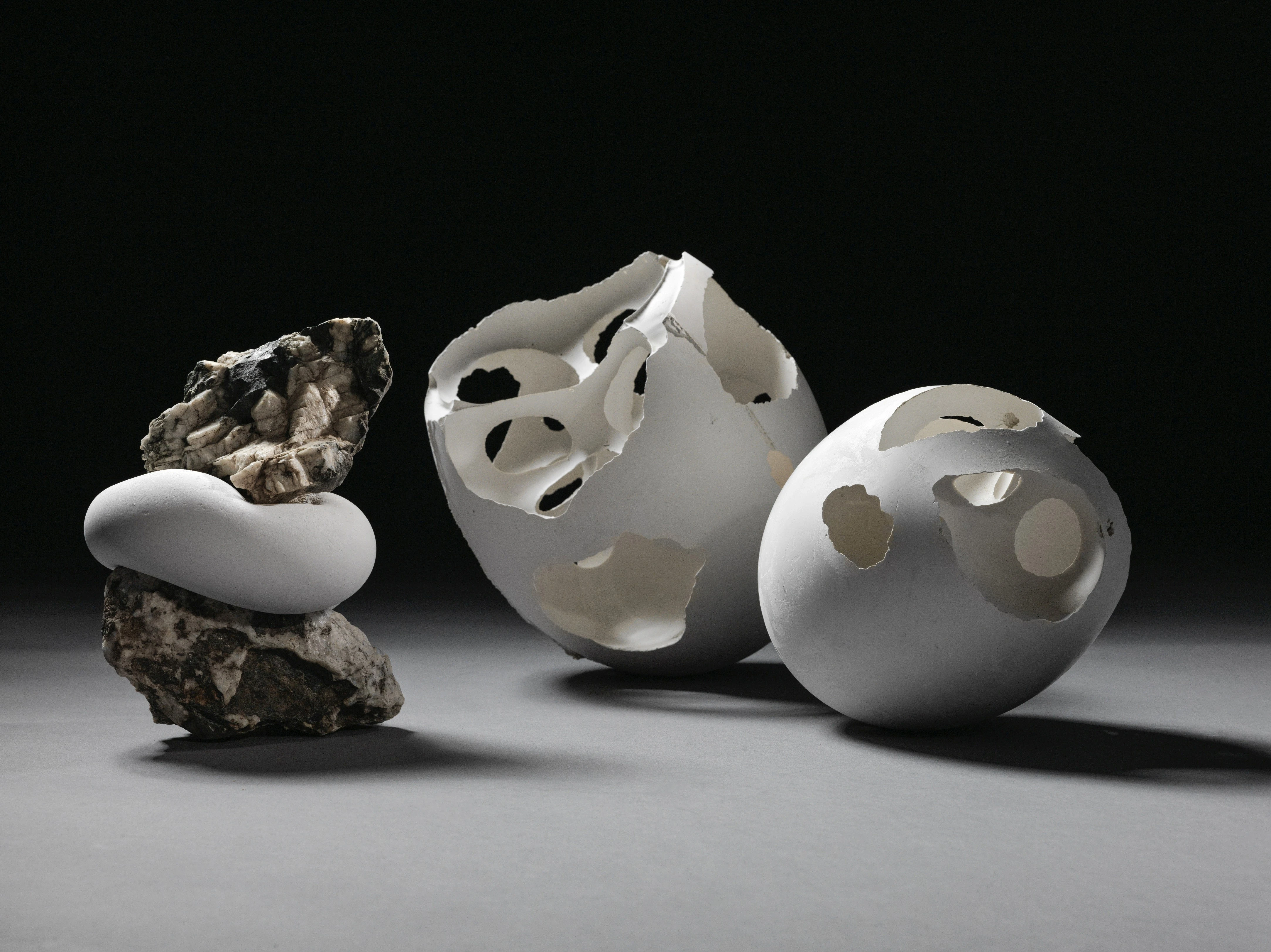
In the 1980s, her work became fundamentally connected to the environment of her own studio and garden in Košice, where she explored the themes of natural processes, growth, and destruction through egg-like forms: "Instead of a closed volume in space as a monolithic unit, the inner space within the organism of the sculpture itself opens up.
Open shell structures emerge with an exposed constructional skeleton, where the interplay of positive and negative volumes — void, cavity, trace, the imprint of form — creates intense internal tension. A stigmatised, destroyed form is born: an archaeology of shape charged with powerful existential weight." (V. Beskid) Bartuszova's work represents a unique contribution to the sculpture of the second half of the 20th century, one that unites material research, corporeality, and a sensitive perception of the relationships between object, landscape, and human being.